
What a Strata Cleaning Scope Should Include
Most strata cleaning disputes come from a vague scope, not poor work. What a common-area scope should specify, task by task.
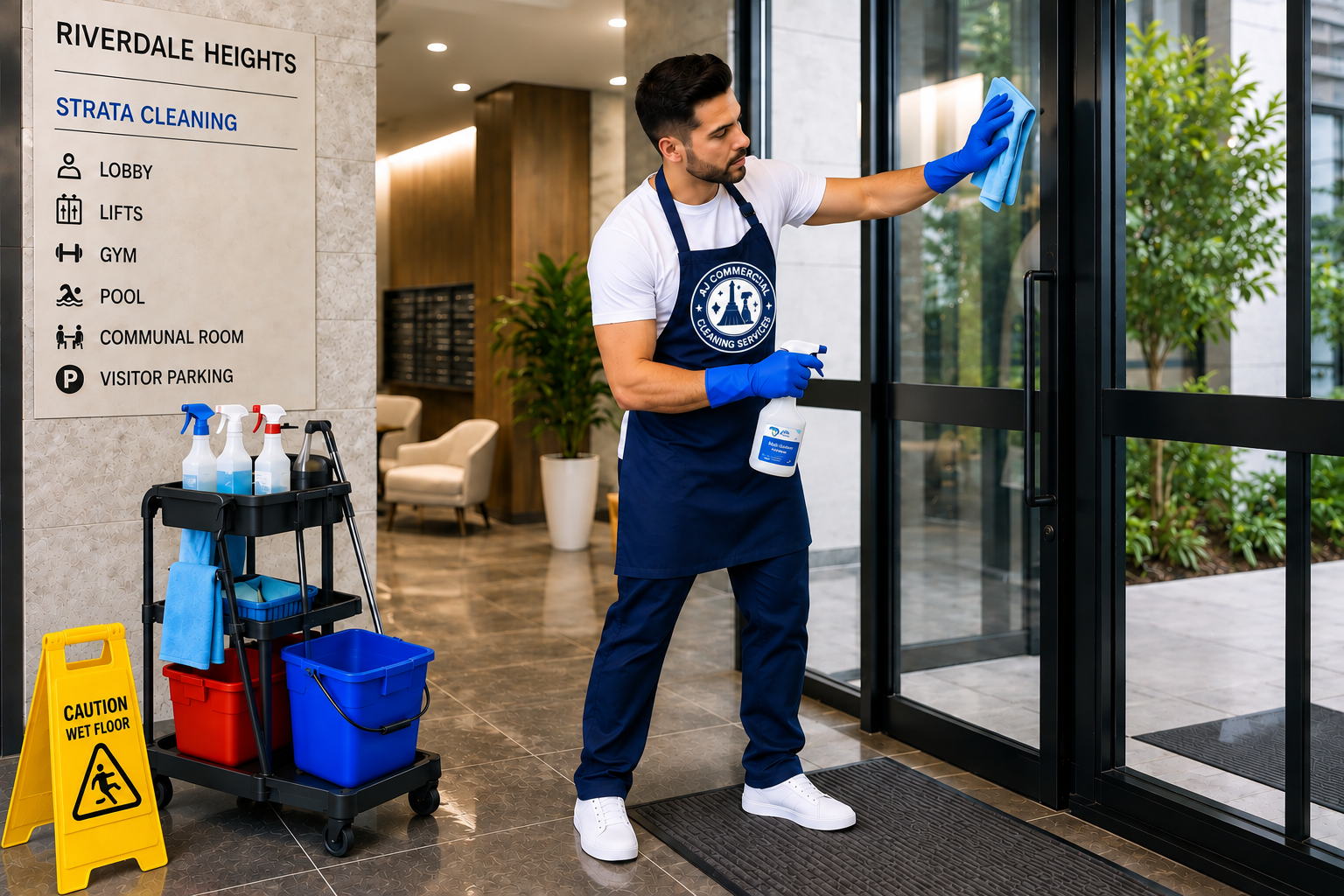
Almost every strata cleaning dispute we see comes down to the same thing: the scope said "clean common areas" and left everyone to guess what that meant. The cleaner thought the basement car park was excluded. The committee assumed it was included. Nobody wrote it down, and the argument arrives six months later at a general meeting.
A good strata scope is boring, specific and slightly longer than anyone wants it to be. Here is what it should cover.
Define the areas before defining the tasks
Start with a list of every space the contract covers, named the way residents name them. Not "common areas" — the actual list:
- Entry lobby, mailbox area and intercom panel
- Lift cars, lift lobbies on every level, and lift door tracks
- Internal stairwells and fire stairs
- Corridors on each residential level
- Basement or ground-level car park, including visitor bays
- Bin room and bin chute openings
- Letterbox bank and parcel area
- Pool surrounds, gym or common room, if present
- External entry paths, steps and the street-facing frontage
Then, just as importantly, list what is excluded. Balconies. Inside private lots. Roof areas. Anything requiring height access or a licence. An exclusion list prevents more arguments than an inclusion list does.
Specify frequency per area, not per building
A single building can reasonably run four different frequencies at once, and a scope that applies one blanket frequency to everything is either overspending or underdelivering somewhere.
- Lobby and lift cars. These set the impression of the whole building and usually justify the highest frequency — often two or three times a week in a mid-size block.
- Residential corridors. Weekly vacuum or mop is normally enough unless the building has heavy pet traffic.
- Fire stairs. Monthly is common. They are low-traffic but attract dust and cobwebs fast, and they are on the fire-safety inspection path.
- Bin room. This is the one area where under-cleaning creates a genuine health and pest problem. Weekly minimum, more in summer, with the floor actually washed rather than swept.
- Car park. Quarterly sweep or blow-down, with pressure washing on a longer cycle.
The tasks people forget to write down
These are the items most often missing from a scope, and most often the source of complaints:
- Lift door tracks. They collect grit and they are visible every time someone waits for the lift.
- Glass on entry doors, at hand height. The single most-noticed surface in any building.
- Cobwebs at ceiling junctions and external light fittings. Fast to do, immediately obvious when skipped.
- The bin chute opening itself, not just the floor around it.
- Intercom panel and mailbox fronts, which are touched constantly.
- Skirtings and corridor edges, where vacuum lanes stop short.
- Light fittings in stairwells, which change how clean the whole stairwell reads.
Consumables, waste and who supplies what
Write down who provides bin liners, who moves bins to the kerb and back, and who is responsible when a resident leaves a mattress in the bin room. These three questions cause a disproportionate share of strata disputes.
Bin presentation — moving bins out for collection and returning them — is a separate service from cleaning. It runs on the council collection calendar rather than the cleaning schedule, and it should be priced and scheduled separately, or explicitly excluded.
Reporting that survives a committee change
Strata committees turn over. The cleaner who has been servicing a building for four years may be the only person who remembers what was agreed. That is a risk to both sides.
A workable scope specifies:
- A per-visit log of what was completed, dated
- A named contact for the contractor and for the owners corporation
- A defined way to report an issue between visits, and an expected response time
- A scheduled scope review, at least annually
Per-visit logs sound like overhead until the first time a committee asks whether the fire stairs were done in March. Then they are the cheapest part of the contract.
Access, keys and after-hours work
Common-area cleaning usually happens outside resident hours, which makes access the practical constraint. The scope should record how the contractor gets in, who holds keys or fobs, and what happens when a fob stops working at 6am on a Saturday. Buildings with restricted lift access need this written down or the work simply does not happen.
If the building has noise restrictions — and most residential strata does — say which tasks are affected. Pressure washing and floor machines at 6am will generate complaints no matter how good the result is.
A scope is a shared memory, not a legal weapon
The point of writing all this down is not to catch a contractor out. It is so that everyone involved a year from now — a new committee, a new building manager, a new cleaner — can read one document and know what was agreed.
Our strata cleaning contracts are written to this shape, area by area. If your building's current scope is a single paragraph, it is worth rewriting before the next tender rather than after the next complaint. We are happy to walk a building and draft a scope you can put out to tender, whether or not you use us for the work. Get in touch and we will put it in writing.
Keep reading

How to Change Cleaning Contractors Without a Gap
Most of the pain in switching cleaners is handover, not notice. The sequence that gets a new contractor onto a site without a week of complaints.

School and Childcare Cleaning Standards in NSW
What a cleaning contractor on an education site has to get right in NSW — clearances, touch points, term and holiday programs, and outbreak response.
What Commercial Cleaning Actually Costs in Sydney
What drives a cleaning price in Sydney, why per-square-metre rates mislead, and how to check whether a quote has enough hours in it to be real.