What to Expect from Medical and Clinical Cleaning
Clinical cleaning is a documented process, not just a deeper clean. The principles that separate it from ordinary commercial work.
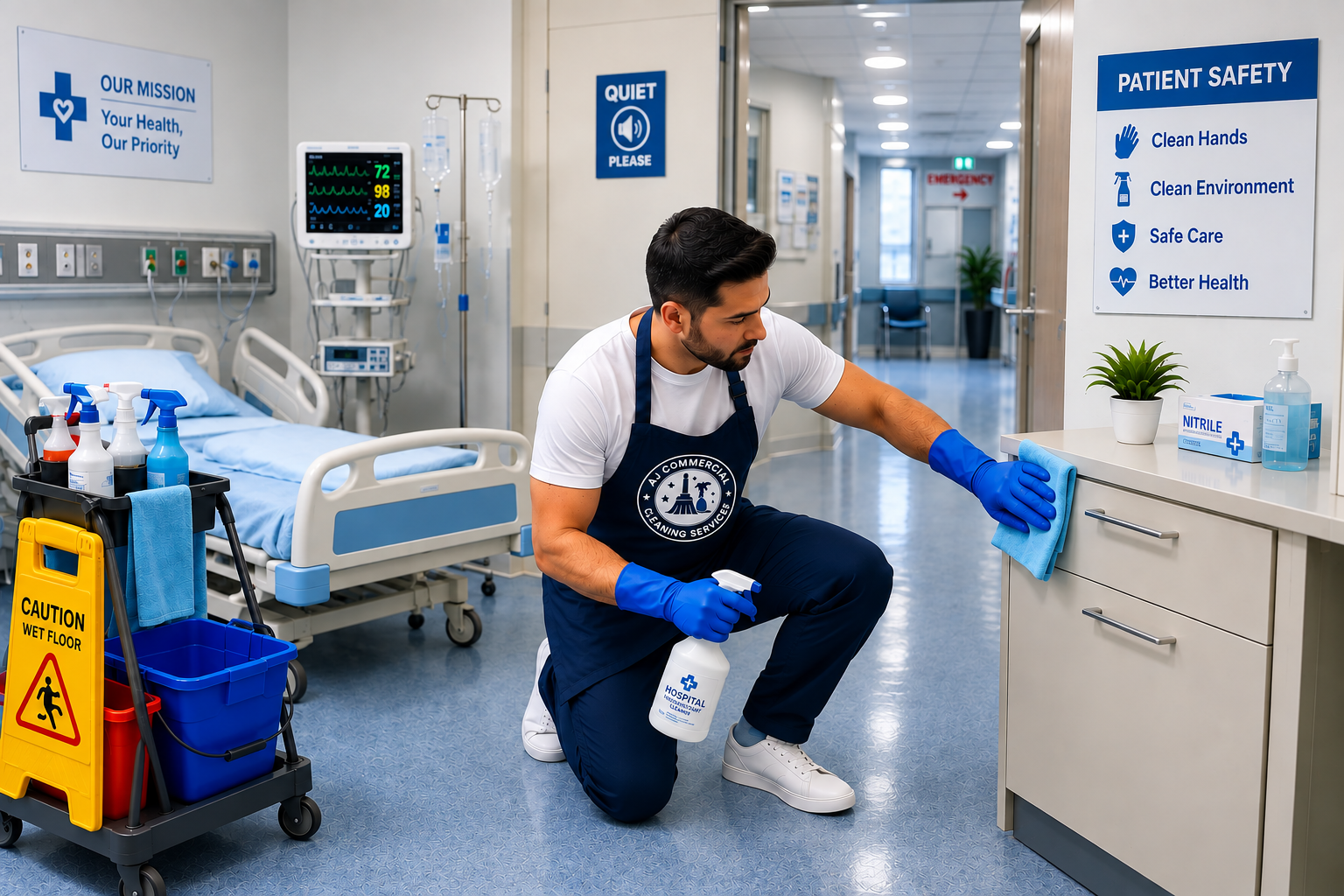
The difference between commercial cleaning and clinical cleaning is not effort, and it is not stronger chemicals. It is that clinical cleaning is a documented, repeatable process where the sequence matters as much as the result, and where "it looks clean" is not the standard being met.
If you run a medical centre, dental practice, allied health clinic or day surgery, this is what a competent contractor should be bringing to your site.
A note on scope: requirements differ substantially between a GP practice, a dental surgery and a hospital, and they are set by your own accreditation and state health requirements. Treat the principles below as what to expect from a contractor, and confirm the specifics against the standards your facility is accredited under.
Cleaning and disinfection are two different steps
These get used interchangeably in conversation and they are not the same thing.
Cleaning physically removes soil, organic matter and most microorganisms using detergent and mechanical action. Disinfection reduces remaining microorganisms on an already-clean surface using a chemical agent.
The order is not optional. Disinfectant applied to a soiled surface is largely wasted — organic matter interferes with most disinfectant chemistry, so you get the cost and the contact time without the result. A contractor who sprays disinfectant onto visible soil and wipes once is not doing clinical cleaning.
Contact time is the other half of it. Every disinfectant has a manufacturer-specified dwell time, and a surface wiped dry immediately has not been disinfected. Ask your contractor what products they use and what dwell time those products require. If they cannot answer, that is informative.
Colour coding and cross-contamination control
Colour-coded cloths and equipment exist so that a cloth used in a washroom never touches a treatment surface. The specific colour scheme varies between facilities; what matters is that one exists, that staff follow it, and that it is written down rather than remembered.
The same logic applies to mop heads and buckets. Separate equipment for clinical areas, washrooms and general office space is the baseline. Laundering and replacement schedules for cloths and mop heads should be part of the scope, not an afterthought.
Sequence: clean to dirty, high to low
Clinical cleaning follows a route, and the route is part of the method.
- Clean areas before dirty areas. Consulting and treatment rooms before washrooms, never the reverse.
- High surfaces before low. Anything dislodged falls onto surfaces still to be cleaned, not onto ones already finished.
- Dry work before wet work, so dust is not turned into smears.
A contractor working a site in a different order every visit is producing a different result every visit.
Touch points are the priority surface
In a clinical setting the highest-risk surfaces are not floors. They are the things hands contact repeatedly between patients:
- Door handles, light switches and taps
- Treatment chairs, couches and adjustment levers
- Bed rails and armrests
- Keyboards, mice and EFTPOS terminals
- Reception counters and pens
- Waiting-room seating, especially armrests
- Toy boxes and shared items in paediatric waiting areas
These should be explicitly listed in the scope with their own frequency, not folded into a general "wipe surfaces" line.
What documentation should look like
This is where clinical cleaning most clearly differs from commercial work. If it was not recorded, it is very difficult to demonstrate at an accreditation visit.
Expect, at minimum:
- A per-visit record of areas completed, dated and identifiable to a person
- Product safety data sheets held on site for every chemical used
- A written cleaning schedule per area, with frequencies
- A defined process for blood and body-fluid spills, and evidence staff are trained in it
- Records of staff induction to your specific site
Ask to see a sample of the per-visit record before signing. A contractor who produces one immediately has done this before.
Waste streams
Clinical waste segregation is the practice's legal responsibility, not the cleaner's, but the cleaner has to work within it. The scope should say plainly which waste streams the cleaning team handles and which they never touch. Ambiguity here is a genuine risk, and it is resolved in one sentence.
Scheduling around patients
Most clinics cannot be cleaned during consulting hours, and most cannot be left until the weekend either. The practical answer is usually a split: a full clean outside operating hours, plus an agreed procedure for between-patient turnover that practice staff carry out themselves.
Be explicit about which tasks belong to the contractor and which belong to your clinical staff. Between-patient surface disinfection is almost always the practice's own responsibility, and a scope that leaves it unclear leaves a gap.
Questions worth asking a prospective contractor
- What disinfectant do you use here, and what is its required contact time?
- What is your colour-coding system, and where is it written down?
- How are your staff trained for clinical sites specifically?
- What does your per-visit record look like?
- What is your documented process for a body-fluid spill?
Five questions, and the answers will tell you quickly whether a contractor works in clinical settings routinely or is quoting on one for the first time.
This is how our hospital and medical cleaning scopes are built. If you would like a scope drafted for a clinical site — with frequencies, touch-point lists and the reporting format set out in writing — tell us about the practice and we will walk it with you.
Keep reading
How to Change Cleaning Contractors Without a Gap
Most of the pain in switching cleaners is handover, not notice. The sequence that gets a new contractor onto a site without a week of complaints.
School and Childcare Cleaning Standards in NSW
What a cleaning contractor on an education site has to get right in NSW — clearances, touch points, term and holiday programs, and outbreak response.
What Commercial Cleaning Actually Costs in Sydney
What drives a cleaning price in Sydney, why per-square-metre rates mislead, and how to check whether a quote has enough hours in it to be real.