
When a Commercial Property Needs Pressure Washing
Which surfaces need high pressure, which need soft washing, how often, and the runoff rules that catch out contractors on Sydney commercial sites.
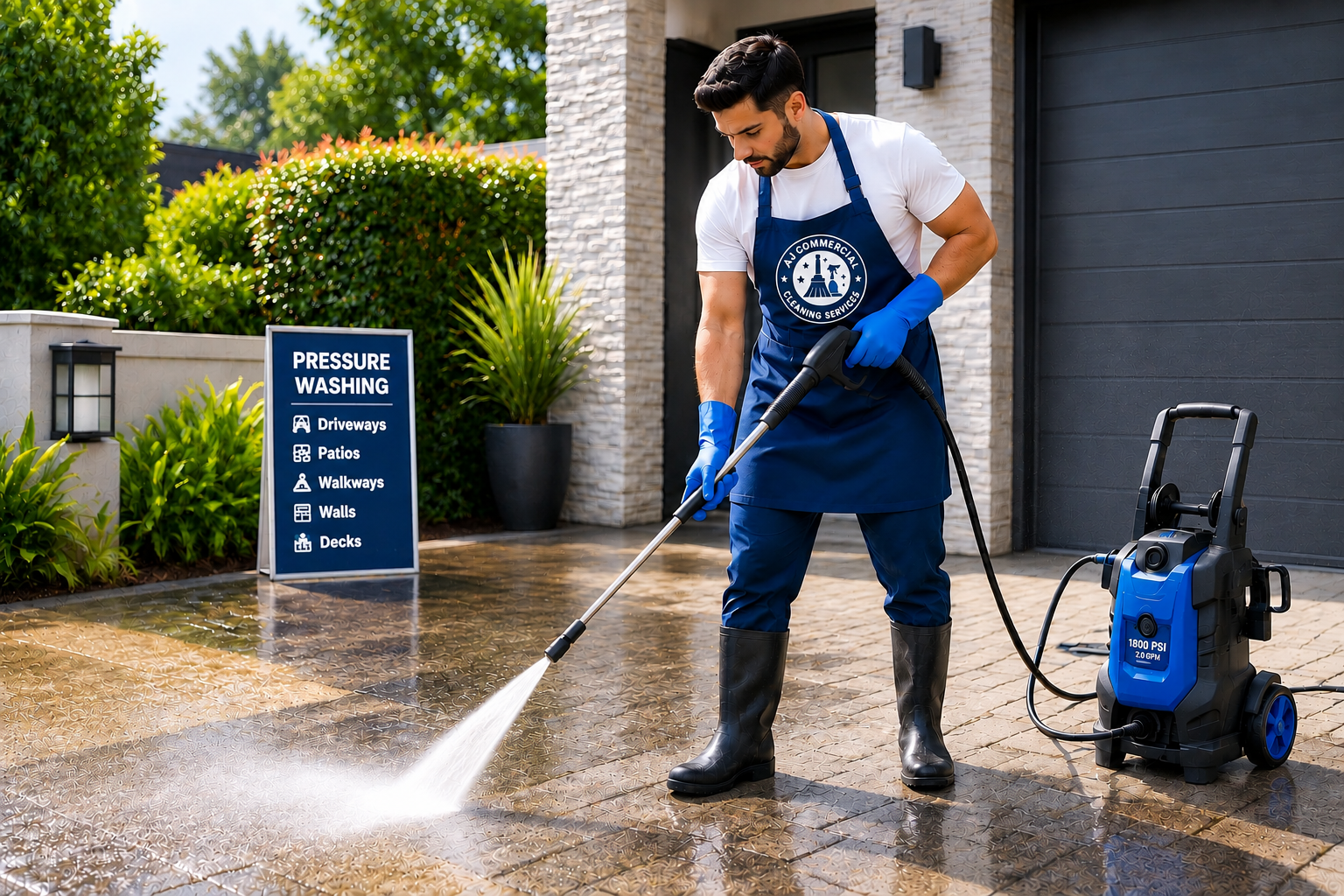
Most exterior cleaning gets ordered when a building already looks bad. By then the staining has usually been there long enough to be doing damage, and the clean that would have taken half a day takes two.
Exterior surfaces are the part of a property that everyone sees before they walk in and nobody has scheduled. Here is when different surfaces actually need attention, and why more pressure is often the wrong answer.
High pressure is a tool, not the job
The instinct is to point the highest available pressure at the worst-looking surface. On the wrong material that removes the stain and a layer of the substrate with it.
Broadly, surfaces divide into three groups.
Takes genuine high pressure. Unsealed concrete, driveways, loading docks, kerbs, industrial hardstand. These are dense, unfinished and tolerant. This is where high pressure and a surface cleaner attachment do the work properly and evenly.
Needs moderate pressure and technique. Pavers, exposed aggregate, tiled entries, sealed concrete. Too much pressure blows out jointing sand, strips sealer and leaves wand marks that are permanent and obvious in raking light. These want a controlled pressure, the right fan angle and consistent distance.
Needs soft washing, not pressure. Rendered walls, painted surfaces, cladding, Colorbond, signage, roof sheeting, timber. The cleaning here is chemical — a detergent or biocide does the work over a dwell time, and low pressure rinses it off. Hitting render with high pressure drives water into the wall and can take the finish off in patches you will then be paying to repaint.
If a contractor's answer to every surface on your site is the same machine at the same setting, they are going to damage something.
What the black staining actually is
The dark patches on paths, north-facing walls and shaded concrete are usually biological — algae, lichen and mould, not dirt. That distinction changes the treatment.
Pressure alone removes the visible growth and leaves the root structure in the pores of the surface. It looks clean for a few weeks and comes back faster each time, which is why some sites end up on a pointless quarterly cycle.
Treating it properly means a biocide with enough dwell time to kill the growth, then rinsing. Done that way the interval between cleans stretches out considerably. If you are washing the same path every three months, you are removing the symptom.
Sensible intervals for a Sydney site
Sydney's humidity and coastal exposure push biological growth harder than a dry inland climate, and shaded southern elevations hold moisture for most of winter.
As a starting point, adjusted for how much sun and traffic each area gets:
- Entries, foyer approaches and customer-facing paths — two to four times a year. This is the first impression and it is worth the frequency.
- General paths and car parks — annually, or twice if shaded.
- Loading docks and bin areas — quarterly. These stain from use rather than weather and they are a hygiene issue as much as an appearance one.
- Building facades and render — every one to three years, sooner on southern and shaded elevations.
- Roof and gutter areas — inspect annually; clean on condition.
- Outdoor dining and seating areas — monthly to quarterly during use, because these are food surfaces in effect.
The exception to all of it is a safety trigger. Any smooth surface carrying pedestrian traffic that has developed algae or moss is a slip hazard, and that overrides the schedule.
Runoff is the part contractors get wrong
This is the detail that turns a routine job into a problem for the property owner.
In NSW, letting anything other than clean water enter the stormwater system is an offence under the Protection of the Environment Operations Act. Stormwater drains run to waterways untreated. Detergent, oil lifted off a car park, silt from a facade, paint residue and biocide are all pollutants, and the liability does not stay with the contractor.
Ask before work starts:
- Where is the wash water going?
- Are drains being bunded or covered?
- Is water being captured and disposed of to sewer under a trade waste arrangement, or collected for removal?
- What products are being used, and are they appropriate to go where they are going?
On a bin area or a car park with hydrocarbon staining this is not a technicality — it is the main compliance question of the job. A contractor who has not raised it before you did is planning to hose it into the nearest grate.
Water restrictions and access
Two practical constraints that decide when the work can happen at all.
Sydney Water restrictions affect pressure washing of hard surfaces, with exemptions that generally cover health, safety and preparation for painting or sealing. Check the position at the time of the job rather than assuming last year's rules.
Access is the other one. Most commercial exterior work has to happen outside trading hours, and anything above ground level brings height-safety requirements, exclusion zones below, and often a scaffold or elevated work platform. That changes the cost and the lead time, so it belongs in the conversation early rather than as a variation.
What to ask for in a quote
- Which surfaces, treated by which method, at what pressure
- Whether biological growth is being treated or just blasted off
- The runoff plan, in writing
- Public liability cover and, for elevated work, the height-safety arrangements
- Whether sealing is recommended afterwards, and whether it is included
- Expected interval before the surface needs doing again
That last one is the useful question. A contractor who tells you the path will need doing again in three months is telling you what method they are using, whether they mean to or not.
Our exterior work is quoted surface by surface with the method named against each, and the runoff arrangement agreed before anyone turns a tap on. If you have staining you are not sure about, send a photo — we will tell you what it is and whether it needs pressure at all.
Keep reading

How to Change Cleaning Contractors Without a Gap
Most of the pain in switching cleaners is handover, not notice. The sequence that gets a new contractor onto a site without a week of complaints.

School and Childcare Cleaning Standards in NSW
What a cleaning contractor on an education site has to get right in NSW — clearances, touch points, term and holiday programs, and outbreak response.

What Commercial Cleaning Actually Costs in Sydney
What drives a cleaning price in Sydney, why per-square-metre rates mislead, and how to check whether a quote has enough hours in it to be real.